Tuesday, May 5, 2015

Igneous

Intrusive Ore Deposit

Intrusive ore Deposits
Chromite "Chromium ore deposit types"
Both olivine and chromite deposits are closely associated with ultramafic plutonic rocks. The bulk of chromite reserves occur in the large, laterally extensive stratiform where tabular seams prevail or Bushveld-type form occurring in stable shield areas as exemplified by the Bushveld Igneous Complex in South Africa, the Great Dyke of Zimbabwe, northern Finland, and Bahia State, Brazil. In contrast, the smaller podiform or Alpine-type deposits occur in mobile belts "in the mantle section of ophiolites" such as the Urals of the former U.S.S.R.; the Tethyian mountain chain of the Balkans, Turkey, and Iran; and the Circum-Pacific belt. Overall, significant chromite reserves and production are restricted to fewer than 10 countries, and nonmetallurgical grades to still fewer, namely South Africa, the Philippines, Turkey, Greece, Finland, Albania, and India.
Global Chromite Resources Map
Source: Department of Mineral Resources, South Africa, Heinz H. Pariser

The Bushveld contains giant exploitable resources of 2300Mt of mainly metallurgical chromite at >50% Cr2O3 (Vermaak 1986). Genetically similar but much smaller deposits occur in the Great Dyke, Zimbabwe and the Stillwater Complex, Montana. In the Great Dyke, massive chromitite dykes (offsets) extend 100m downwards into footwall sandstone and conglomerate.
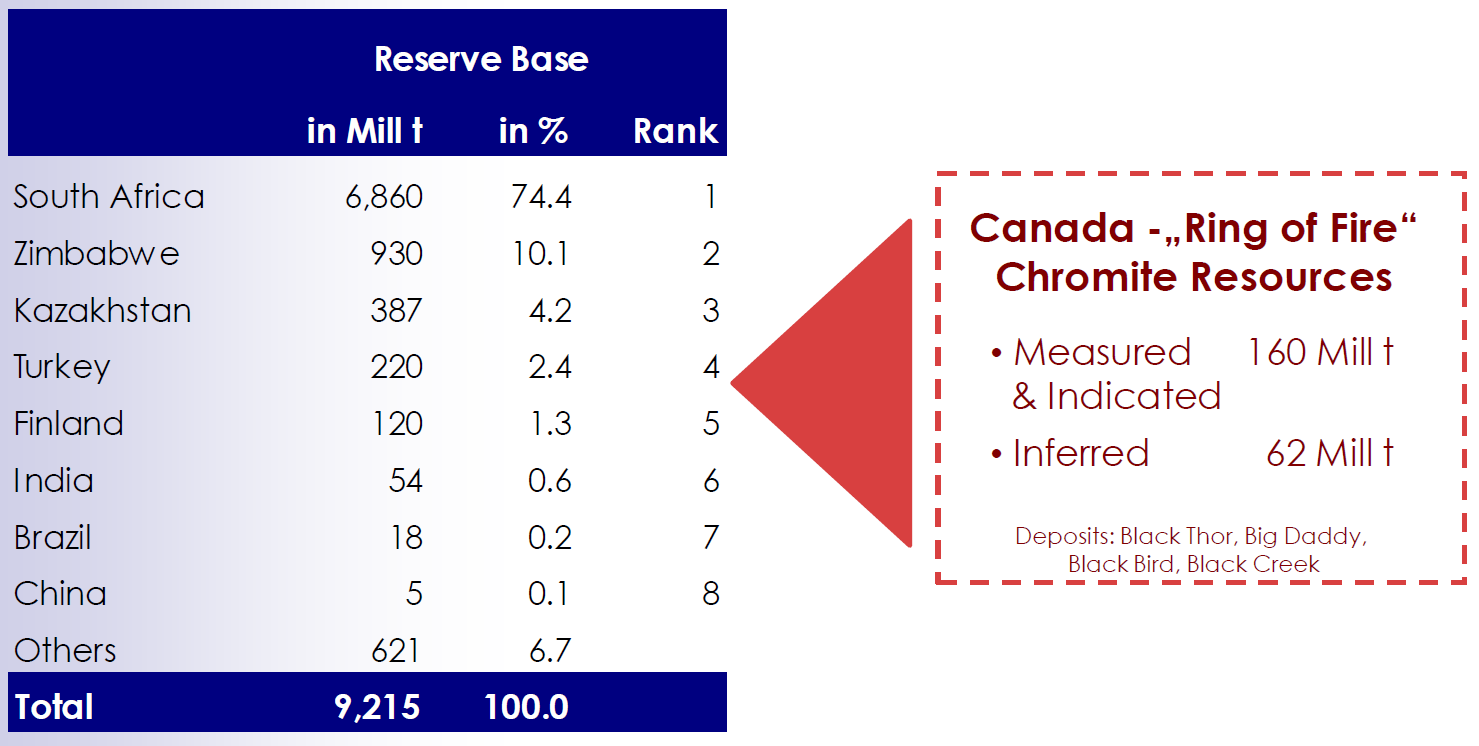
Chromite resources are very large and sufficient for centuries of consumption. However, only two countries control 90% of the resources (South Africa and Kazakhstan), implying a certain geopolitical risk.
Exploration for podiform chromite is challenging. Outcropping ore has been found and exploited long ago. Deep orebodies are sought by a combination of detailed geological mapping, structural geology and geophysical methods for locating high-density or magnetic material at depth (gravimetric and magnetic methods). Seismic methods may help to locate massive ore. Stratiform chromite seams are found by geological and petrological investigations. Note that it is always advisable to examine any chromitite for possible by-product platinum element contents.
World Chromite Ore Reserve Base / Mine Production
Source: Department of Mineral Resources, South Africa, Heinz H. Pariser
Global Chromite Supply
Source: Department of Mineral Resources, South Africa, Heinz H. Pariser
Ore & Concentrate Trade Flow
Source: Department of Mineral Resources, South Africa, Heinz H. Pariser


Olivine

Olivine Forsterite (Mg) and fayalite (Fe2) are end members of a continuous solid solution series. Manganese and calcium may substitute part of Mg and Fe. Valuable olivine is generally forsteritic. Already in antiquity, it was mined as a semiprecious, clear and translucent mineral (peridote) on tiny Zebirget Island (St Johns) in the Red Sea, Egypt. About 100 years ago, nearly monomineralic olivine rocks (dunite) were first used as a refractory material. With a melting point of 1890C, Mg-rich forsterite is understandably preferred to Fe-rich fayalite (1205C).

Olivine is in demand for manufacturing special refractories, but mainly (75% of total consumption) as a slag conditioner similar to dolomite in pig iron production. In this sector, iron content of olivine is accepted. The use of olivine is advantageous because it replaces dolomite and reduces coke consumption, thereby diminishing CO2 emissions. Olivine is also used for sintered heatstorage elements in electrical heating appliances where it competes with magnesia made from magnesite. 
Commercial olivine and dunite deposits are common in alpine-type ultrabasic terrains. A limited market restricts production to Norway"The world’s largest olivine mine is Aheim in western Norway", with 80% of world production; smaller producers are Spain, Italy, Japan, and the United States. The modest U.S. production is from North Carolina and Washington. Nepheline Syenite Nepheline syenite is a relatively common, silica-deficient, magmatic intrusive rock. Commercial production, however, is limited to large operations in Canada, Norway, and the former U.S.S.R. because of the limited market size, competition from feldspar, and the requirement for a consistently low iron content. Production from Canada and Norway is virtually all exported; this accounts for 70% and 30%, respectively, of world production, excluding the former U.S.S.R.
International statistics on olivine (dunite) production are incomplete and most is probably comprised in the giant class of “crushed stone and aggregates”. A large seaside quarry at Atammik between the capital Nuuk and Maniitsoq in Greenland, with an annual production of 1 Mt, was put on hold in 2009.

Nepheline syenite 
Nepheline syenite is a relatively common, silica-deficient, magmatic intrusive rock. Commercial production, however, is limited to large operations in Canada, Norway, and the former U.S.S.R. because of the limited market size, competition from feldspar, and the requirement for a consistently low iron content. Production from Canada and Norway is virtually all exported; this accounts for 70% and 30%, respectively, of world production, excluding the former U.S.S.R.
It also provides a source of unusual mineral specimens and rare earth elements (REE) extraction. The industrial use of Nepheline syenite includes refractories, glass making, ceramics and, in pigments and fillers. It is also used as construction facade, interior wall texture, and countertops.

Diamonds
Most diamonds formed in the Earth’s lithospheric mantle, at high pressures and relatively moderate temperatures. Diamonds are brought to the surface by volcanic eruptions that originate from these source regions defined by the “cool” 40mW/m2 mantle geotherm of Pollack & Chapman (1977).The primary geological habitat for natural diamond is kimberlite, an ultrabasic intrusive rock associated with stable shield regions. Diamondiferous kimberlites are concentrated in southern Africa, the Siberian Platform, Brazil, and Western Australia. Ages range from Precambrian in South Africa to Recent in Tanzania. Diamonds are also produced commercially from placer deposits such as in Namibia (see Sedimentary section ). Overall, Africa is a prime region for diamond production, in particular South Africa, Botswana, Namibia, Lesotho, Swaziland, and Angola.
Industrial diamond is foremost an abrasive that is used for drilling, grinding, sawing and polishing. Useful properties apart from its hardness include toughness, resilience against aggressive chemicals and high-temperature stability. Applications are numerous, ranging from microsurgery to deep drilling for petroleum and cutting large monolithic dimension stones. Most of this market is served by synthetic diamonds.

World's top 17 diamond producing countries for 2011 and 2012

<

Lithium
Lithium tends to concentrate in silicic rocks and pegmatites containing feldspar, quartz, and mica in places such as Bernic Lake, Manitoba, Canada (spodumene, lepidolite); Greenbushes, Western Australia (spodumene); and Bikita, Zimbabwe (petalite, spodumene, lepidolite, eucryptite). Although lithium-rich pegmatites are separated to form a lithium concentrate plus by-product feldspar, quartz, or mica, these pegmatitic sources of lithium have been strongly challenged by lithium extracted from brines in Chile and Argentina (in fact, the availability of lithium from brines forced the closure of a hard-rock operation in the Kings Mountain area of North Carolina).
Dentified lithium resources total 5.5 million tons in the U.S and approximately 34 million tons in other countries. Identified lithium resources for Bolivia and Chile are 9 million tons and in excess of 7.5 million tons, respectively. Identified lithium resources for Argentina, China, and Australia are 6.5 million tons, 5.4 million tons, and 1.7 million tons, respectively. Canada, Congo (Kinshasa), Russia, and Serbia have resources of approximately 1 million tons each. Identified lithium resources for Brazil total 180,000 tons.
World map of Lithium Distribution
World map of Lithium Distribution Source"USGS"
Lithium minerals may be associated with pollucite CsAlSi2O6.H2O, which is the main carrier of caesium (crustal abundance 3 ppm, density 1.892 g/cm3, melting point 28.64 C), as in the Bernic Lake rare metal pegmatite (Tanco mine, Manitoba), which contains 300,000 t pollucite with an average Cs2O content of 24% (USGS 2010). Other sources include caesium beryl exploited from Li-rich pegmatites and lithium brines. Caesium is part of X-ray tubes, atomic clocks, scintillometers, magnetometers and special glasses. Most of it is processed into caesium formate (CsOOH) brine, which is non-toxic and displays a high density (2.3 g/cm3) making it a useful ingredient of high-pressure and high-temperature drilling fluids (e.g. ultra-deep holes in hydrocarbon exploration).

Mining for Lithium:
Most lithium is recovered from brine, or water with a high concentration of lithium carbonate. Subsurface brines trapped in the Earth’s crust are the major source material for lithium carbonate. These sources are less expensive to mine than from rock such as spodumene, petalite, and other lithium-bearing minerals.

Brine production of lithium begins by first pumping the brine into evaporative ponds. Over 12 to 18 months, concentration of the brine increases to 6,000 ppm Li through solar evaporation. When the lithium chloride reaches optimum concentration, the liquid is pumped to a recovery plant and treated with soda ash, precipitating lithium carbonate, which is then filtrated, dried, and shipped.


Beryllium
One of the most important industrial metals in the world. Although beryl is also associated with pegmatites in locations such as Brazil, the former U.S.S.R., and western Canada, production of bertrandite in Utah now accounts for 80% of the world’s beryllium supply.
The reason this metal is so important is because of its physical properties.  It is twice as light as aluminum, has an incredibly high melting point at 1287°C, it is not affected by air or water even when it is red hot, and it is many times stronger that other metals, even engineered metals such as titanium and steel alloys.It is used in a wide range of tools including chisels.  It is used in high-end clock and watch movements.  It is used for making bearings that will resist extreme heat.  It is also very corrosion resistant when alloyed with copper. Because of its high strength and light weight it is used to hold the guidance systems in many missiles and rockets.
Economic sources of beryllium are only: epithermal stratiform volcanogenic beryllium impregnations in rhyolite tuffite; rare element pegmatites of the lithium-caesiumtantalum (LCT) type.Several epithermal stratiform volcanogenic beryllium deposits occur in the area of Spor Mountain in Utah, USA.


Bertrandite Mining:
Unlike beryl, in which the mineral can be identified by color and crystal structure, bertrandite mineralization cannot be recognized by the naked eye. Consequently geologic and geochemical evaluations are conducted on a specific area, followed by a drilling program to determine if an economic ore body exists.After delineating an ore body, overburden is removed to within 2 m of the ore.  In the 2-m cover remaining, drill benches are constructed on 7.5-m centers to take samples of the ore body at 0.6-m intervals. Information obtained from analyzing the samples allows cross sections and contour maps to be developed. These maps are used to plan the mining and processing operations.

After the maps are prepared, the remainder of the overburden is removed, and the ore is mined, typically with a self-loading scraper. Because of the irregular ore-grade distribution in the ground, the ore is mined from areas defined by drill data and placed in a stockpile in layers to obtain a more homogeneous blend. Further drilling, sampling, and assaying of the stockpiled ore is then performed to generate a map that delineates ore-grade distribution throughout the stockpile. On the basis of the grade distribution, stockpiled ore is selectively trucked to the mill for further processing.

Fluorspar

Fluorite is commercially named fluorspar composed of calcium fluoride (CaF2).  It is the principal source of fluorine. The same is used in production of hydrofluoric acid, which is used in a wide variety of industrial applications including glass etching. Fluorite tends to occur in well-formed isometric crystals, forming cubes and octahedrons. It also occurs in both massive and earthy forms, and as crusts or globular aggregates with radial fibrous texture.
Fluorspar is a “persistent” mineral occurring in various ore deposits, including Mississippi Valley (lead/zinc) type deposits, hydrothermal veins, stratabound or Manto deposits, contact metamorphic terrains, and alkali rock complexes. More than 50% of world production comes from China, with Mexico, Mongolia, South Africa, and Russia adding another 30%. Much of this production is exported, and the availability of attractively priced exports has forced the closure of smaller operations in North America and Europe. Other producers, largely for export, include Brazil, Kenya, Morocco, and Uzbekistan.
Sources:
In some areas, fluorite rich veins may be weathered to depths of as much as 75 m. Such weathered ore, a mixture of clay and fragments of fluorite and detached wall rock, may be mined open pit with draglines, scrapers, or power shovels to depths of as much as 50 m. Below that, underground mining methods, involving modified top slicing or overhead shrinkage stoping, are used.
Vein Mining:
Vein mining is commonly done by shrinkage stoping, cut-andfill, and open stoping where strong walls occur. Closely spaced shrinkage stope bins may give way to widely spaced bins, with electric and air slushers being used in the tops of stopes to transport the overbreak to the ore pass. Air-operated, rubber-tired, muckhaul units can be adapted to in-stope work. Where shrinkage stoping is used, broken ore is commonly moved to the shaft by track haulage using battery-powered locomotives and 1- or 2-t side-dump cars.

With the introduction of diesel haul units of less than 1.5 m in width, mining can be changed from shrinkage stoping to ramp subleveling in veins. Loaders can be served by small diesel trucks carrying 3 to 4 t. Ventilation for the diesel equipment is usually handled by lines of woven plastic tubing. In shafts, bucket hoisting is supplanted by lifting in larger skips. In larger mines, crushers are installed over skip-loading pockets at the shaft bottom, which improves skip loading.
Room and Pillar:
In bedded deposits, room-and-pillar patterns are used, with the widths of rooms governed by roof conditions. Newer equipment has rubber tires and is diesel operated, including the muckhaul units—which have buckets ranging in size from 0.9- to 4.6-m3 capacity—and rubber-tired diesel trucks with 3- to 18-t capacity. Drilling is done by diesel-propelled jumbos in the bedded ore mines, but the jackleg drills are still used in narrower working places and drifts. In multileveled ore bodies, haulage ramps on 12% to 15% grades connect the levels. Vertical raises are used to facilitate ventilation requirements.

Share:

SURFICALLY ALTERED ORE DEPOSITS

SURFICALLY ALTERED ORE DEPOSITS

Feldspathic and Silica Sands and Kaolin

Feldspar-rich deposits subject to weathering break down to form feldspathic sand deposits such as those exploited in the western United States and in Spain. Further weathering forms a mixture of feldspar, silica, and kaolin such as that mined in Bavaria. Still further decomposition through weathering or hydrothermal activity eliminates much of the mica and silica and yields premier-quality deposits of kaolin such as those mined in Cornwall in the United Kingdom, Georgia and the Carolinas in the southeastern United States, and the Amazon Basin of Brazil. These areas produce virtually all the coating-grade material. Other suppliers of quality kaolin include France, Germany, the Czech Republic, Malaysia, and Australia.

Vermiculite
Vermiculite belongs to a group of minerals called the mica minerals. The mica group of minerals includes: biotite, muscovite, lepidolite, and phlogopite.
It is a supergene alteration product formed by the combined effects of weathering and circulating groundwater or derived by alteration of biotite and phlogopite. Large-scale commercial production is confined to South Carolina and Virginia in the United States and the Palabora Complex in South Africa, which contributes 70% of world supplies. Minor quantities come from China, Russia, Brazil, Zimbabwe, Japan, Australia, and Egypt.
Uses:
Vermiculite is used in a number of different applications. The majority of vermiculite is used annually for agriculture and insulation purposes. In agriculture it is used in horticulture and mixed with soil to create a more porous, absorbent soil. As an insulator, it is used both as a heat and sound insulating material. Vermiculite is added to concrete mixtures to create a lightweight concrete mix.


Bauxite
Because residual bauxite deposits result from the tropical weathering of a variety of source rocks, their distribution is based on climatology rather than lithology. Formation is encouraged by long periods of tectonic stability permitting deep and thorough weathering.
Most bauxite deposits are post-Cretaceous in age and many occur in modern tropical regions. Bauxite provinces have been defined as follows:
• Guiana Shield of South America (Venezuela, Guyana, Surinam, Guiana, and parts of Brazil and Colombia)
• Caribbean Shield Province (Costa Rica, Jamaica, Dominican Republic, Haiti, and Puerto Rico)
• Guinea Shield Province (Guinea-Bissau to Togo)
• Cameroon Province (Cameroon, Zaire)
• Australian Province
• European Province (France, Greece, Hungary, and Yugoslavia)
• Others (United States, China, former U.S.S.R., India, and Malaysia).
A dozen countries contribute 95% of world production, with more than 75% coming from Australia, Guinea, Jamaica, China, and Brazil. Nonmetallurgical grades used for refractories, abrasives, chemicals, and aluminum cement are confined to specific deposits in China, Australia, Guinea, Brazil, Guyana, and Suriname.


Manganese
Manganese is found in most geological environments; the commercially more important being sedimentary and residual. Large sedimentary marine deposits of manganese are exploited in Ukraine, the former U.S.S.R., the Kalahari Basin of South Africa, Groote Eylandt in Australia, and Mexico. Residual deposits are important in Ghana and Gabon in West Africa and in Amapá, Brazil. More than 90% of world production comes from eight countries—China, South Africa, Ukraine, Brazil, Gabon, Australia, India, and Kazakhstan.
Nonmetallurgical grades constitute a relatively small percentage of output from these major suppliers, plus smaller tonnage producers such as Ghana, Morocco, and Greece.


Iron Oxides
Iron oxides are generally associated with volcanic activity and sulfide deposits combined with subsequent leaching and diagenic alteration. India is the world’s largest supplier with more than 70% of production, followed by the United States with an additional 10%. European production is centered in Spain, United Kingdom, France, Italy, and Austria (the last being the main source of natural micaceous oxide). Cyprus is noted for its variety of iron oxides, including ocher and umber.

Tripoli
Tripoli is a microcrystalline, friable, high-silica (98% to 99%) material formed from the weathering of siliceous limestone. The only large-scale commercial producers are in the United States, specifically the southwestern Missouri–northeastern Oklahoma region, southern Illinois, and the Ouachita Mountain region of Arkansas. Deposits in the latter region are associated with novaculite.

Zeolites
Natural zeolites are formed through the reaction of pore water with volcanic glass, clay, feldspar, and a variety of other rocks and minerals. Although zeolites have been recognized in virtually all parts of the world, large-scale commercial production is restricted to the western United States, Cuba, Japan, and several eastern European countries, including Bulgaria.
Share:

Sunday, May 3, 2015

METAMORPHIC Ore Deposits

Metamorphic Ore Deposits
Asbestos
Asbestos is found in several metamorphic environments usually associated with ultramafic rocks and serpentinization.
Asbestos minerals were once used in a wide variety of products. However, due to adverse health effects, the use of asbestos in the U.S. has been significantly decreased. In 2013, for example, the total amount used was only 950 tons, all of which was chrysotile, and was mined in Brazil. Many other countries still mine and use asbestos in insulation products due to less stringent health and safety regulations.
Large deposits are exploited in Quebec, eastern Canada; in the Transvaal and Cape Province of South Africa and in Swaziland and Zimbabwe in Africa; Russia, Italy, and Greece in Europe; New South Wales in Australia;; Kazakhstan; and India. 
World Resources:

The world has 200 million tons of identified resources of asbestos. U.S. resources are large but are composed mostly of short-fiber asbestos, for which use in asbestos-based products is more limited than long-fiber asbestos.
Asbestos Mining:
Chrysotile mining developed through a succession of mining practices and equipment. Originally, the simplest hand methods were employed in shallow open-pit workings. Later, when pits reached considerable depth, overhead cableway derricks were used. Now, power shovels and heavy-duty trucks have replaced other loading and transporting equipment for open-pit quarry methods. 
In its early history, most chrysotile was mined in Canada using underground methods, which included glory holes, shrinkage and sublevel stoping, and block caving. Now open-pit mining prevails. Surface mining offers advantages in recovery, grade control, economy, and safety. The shift to open-pit mining resulted mainly from the introduction of large-capacity power shovels, trucks with higher payload capacities, improved rock-drilling equipment, and new blasting agents and techniques.
In Africa, chrysotile is still mined underground. Most ore bodies are tabular in shape with a pronounced dip so that the economic limit for quarry mining is reached at a comparatively early stage. Ore widths in the larger mines commonly range from 20 to 60 m and as much as 120 m. Some ore bodies, notably in the Shabani District of Zimbabwe, are long. In one case, development extended for 5 km along the strike and was being developed or diamond drilled to more than 300 m in depth.
Several underground methods have been used. Sublevel stoping and caving may be initiated by blasting holes drilled upward from sublevel crosscuts, starting first on the hanging-wall side and retreating over a considerable width toward the footwall. Development and retreat also may be along the strike of the ore. In some cases, high pressures tend to develop from an arching effect. These pressures can be released by cutting a vertical slot that may extend to the surface. In the sublevel stoping method, a slot also may be opened across the center of the ore body. The holes that are fanned out from the sublevel drifts are blasted toward the slot, and mining proceeds as a systematic retreat in two directions away from the opening.


Talc
Import Sources (2009–12): China, 35%; Canada, 31%; Pakistan, 18%; Japan, 4%; and other, 12%.The United States and Canada account for about 12% of world talc production with output from Vermont, upstate New York, Montana, Texas, and California in the United States and Quebec and Ontario in Canada. In Australasia, China is by far the largest producer, followed by India, North and South Korea, Japan, and Australia. In Europe, significant talc producers include France, Italy, Austria, Finland, and Norway, along with Russia. In South America, Brazil is the largest producer. 
Ground talc is used as an ingredient in ceramics, paper, paint, roofing, plastics, cosmetics, talcum and baby powders, and a variety of other assorted uses such as making rubber and plastics.
World Resources: The United States is self-sufficient in most grades of talc and related minerals. Domestic and world resources are estimated to be approximately five times the quantity of reserves.

Substitutes: Substitutes for talc include bentonite, chlorite, kaolin, and pyrophyllite in ceramics; chlorite, kaolin, and mica in paint; calcium carbonate and kaolin in paper; bentonite, kaolin, mica, and wollastonite in plastics; and kaolin and mica in rubber.
The total estimated use of talc in the United States, including imported talc, was plastics, 27%; ceramics, 18%; paint, 16%; paper, 15%; roofing, 6%; cosmetics, 5%; rubber, 3%; and other, 10%. One company in North Carolina mined pyrophyllite.


Wollastonite
Wollastonite is formed through the metamorphism of rocks containing silica and calcium. Major producing areas of high-quality wollastonite include the Adirondack Mountains of upstate New York in the United States, southeastern Finland, several provinces in China and India, and Russia.

Wollastonite serves as a flux for welding, a source for calcium oxide, a slag conditioner, and to protect the surface of molten metal during the continuous casting of steel. As an additive in paint, it improves the durability of the paint film, acts as a pH buffer, improves its resistance to weathering, reduces gloss, reduces pigment consumption, and acts as a flatting and suspending agent. In plastics, wollastonite improves tensile and flexural strength, reduces resin consumption, and improves thermal and dimensional stability at elevated temperatures.

Garnet
Garnet is associated with some wollastonite deposits, including one at Willsboro, New York. In the same area of the state, a large-scale hard-rock garnet mine is in operation. Elsewhere in the United States, although there are hard-rock garnet deposits in Maine and Nevada, the most important commercially are placer deposits in Idaho. Garnet is also produced as a by-product of mineral sand operations in Western Australia, India, and Sri Lanka.

Mining methods for the extraction of garnet vary depending on the geologic environments responsible for the host rock. At hard-rock locations, such as the Barton mine in northern New York, open-pit methods have been employed for decades. In China, hard-rock mining may consist of more primitive methods including hand mining.
Garnets are extracted and processed more easily from alluvial deposits. For example, at the Emerald Creek mine in Idaho, garnet is recovered from stream gravels from slots cut by backhoes or small draglines. These gravels are passed through a trammel to reject the oversize, and garnet is concentrated on large wet-jigging tables. The garnet is then shipped to the mill for final processing and packaging.
 Beach deposits, such as those mined in Western Australia and in southern India, lend themselves to low-cost earth-moving techniques using scrapers and bulldozers to cut and excavate benches parallel to the trend of the beach and/or bar deposit. Because manual labor remains central to the operator’s community responsibility in India, mechanized mining provides only a portion of the mine activity there.
In general, processing involves separation of the heavier garnet from lighter gangue minerals and the further separation of garnet into discrete size classes designed to meet the needs of specific markets. Following crushing (which is determined by the nature of the specific deposit or the market served), ores typically are washed to segregate material by specific gravity. Most operators employ traditional spiral classifiers for this step, some in conjunction with hydrosizers. At least one company uses flotation methods for the separation of garnet from heavy nonmagnetic fractions. Concentrates are dried and then sorted by both high-intensity magnetic and electrostatic separators.

One producer that markets very fine grades for precision grinding and polishing markets also relies on wet-separation techniques for quality control. Final separation yields a product exceeding 95% garnet minerals, which usually contains less than 0.5% quartz by weight. The final production step is dry screening and classifying into marketable sizes, then packaging for sales and distribution.


Kyanite Group
The kyanite group of minerals occurs in aluminous metamorphic rocks and their weathered derivatives. Production is restricted to a handful of countries, including South Africa, Russia, the United States, France, India, Sweden, Spain, China, and Zimbabwe. Like garnet, some are found associated with placer mineral sand deposits, particularly in India.
Kyanite Mining:
The kyanite quartzite is drilled and blasted; secondary breaking is sometimes done with a hydraulic hammer. The ore is picked up with diesel-powered shovels, loaded into trucks, and hauled to the primary crusher. At the primary crusher, the ore is reduced to –4 cm and passed by conveyor belt to the rod mill, which is in a closed circuit with a classifier, to grind the ore to –20 mesh.
Water is added that creates a slurry from which the –200 mesh is removed (deslimed). The new slurry is conditioned with several ingredients and passed through a series of flotation cells that remove the pyrite and micaceous contaminants from the slurry. Tailings from the pyrite circuit are again deslimed and conditioned with other reagents and passed through a section of rougher flotation cells. The rougher concentrate goes to a two-stage recleaning circuit; tails of the rougher circuit go to waste.
The ore goes on to further processing in floatation. Then it is dried and magnetically separated until the final product which is a raw -35 mesh kyanite product. 


Pyrophyllite
Weathering may form sericite or pyrophyllite, the hydrous aluminum silicate. The main pyrophyllite deposits, however, are formed through the hydrothermal alteration of acidic volcanic rocks. This is particularly well developed in areas of Japan and the Republic of Korea—accounting for 85% of world production between them. Smaller producers include Canada, the United States, India, China, Thailand, Australia, Brazil, and Argentina. Corundum Natural corundum is another alumina-rich mineral formed through metamorphism. The main producers are Zimbabwe and South Africa, the former U.S.S.R., and India. Production of the impure form, emery, is restricted to Turkey and Greece.
Ground pyrophyllite is used in the production of ceramics, heat-resistant products called fractories, and paint.Soapstone was once used to make chemical-resistant sinks and countertops for laboratories. Before the days of furnaces, blocks of soapstone were heated on stoves and used as bed warmers.

Graphite

It forms as veins and disseminations in metamorphic rocks as the result of the metamorphism of organic material included in limestone deposits. It is the only non-metal element that is a good conductor of electricity.  Natural graphite is used mostly in what are called refractory applications.  One example of this use is in the crucibles used in the steel industry. Such refractory applications account for the majority of the usage of graphite. It is also used to make brake linings, lubricants, and molds in foundries. A variety of other industrial uses account for the remaining graphite consumed each year.
world production is concentrated in fewer than 20 countries, more than 60% is produced in Asia—China, the Republic of Korea, Sri Lanka, and India. In the Americas, Mexico and Brazil are well-established producers, and Canada is emerging as a major supplier. The main producers are Germany, Austria, the Czech Republic, Norway, Romania, Turkey, and Russia in Europe, and Zimbabwe and Madagascar in Africa.

Source of information ....
Economic geology book  2011 by Prof. W.L.Pohl
World Distribution of Industrial Minerals Deposits by Prof. Peter W. Harben
MINERAL COMMODITY SUMMARIES 2014. USGS
Share:

Saturday, May 2, 2015

Why Mineral Exploration?

Why Mineral Exploration
The mineral reserves and resources, annual production vs. consumption and index of per capita spending of any commodity are the measures that rank the status of a country as developed, developing or underdeveloped. The per capita consumption of zinc in India during 2008 was very low at 0.43 kg against a world average of 4.3 kg. The higher consumption during the same period was shared between Australia (12.7 kg), South Korea (11.3 kg), Canada (5.6 kg), Japan (5 kg), USA (4.1 kg) and China (2.7 kg). The policy makers in the Government and Private Sectors allocate funds for long- and short-term exploration plan programs guided by the demand-supply trend of all commodities as a whole. The fund allocation has special significance for strategic and deficient minerals. The annual percent satisfaction between consumption and indigenous production of zinc metal between 1992-1993 and 2009-2010 at an annual growth rate of 8-10% has been depicted.
The existing demand-supply disparity can be reduced by expanding the mining and smelting capacity with the on hand ore reserves as short-term ad hoc measure. The ultimate way out for long-term standpoint would be continuous efforts to enhance reserve and resource base. This is possible by new search, discovery and adequate exploration of mineral deposits, economic mining and smelting.
The process of mineral discovery and its development to a target production center takes a long gestation period of about 5-20 years. In terms of business requirements, this translates to a very high-risk tolerance at all levels, extensive period of time and rich pockets for a sustained cash flow. A small business unit in this field may often end its brief tenure with a total loss, in case of failure to make an economic return. Indeed, many of the discoveries are not viable at current market prices. Prima facie, the facts might indicate that investment in these ventures is a waste. However, one discovery out of 100 or even 1000 attempts may pay back the entire efforts. The task of policy maker is to plan timely allocation of funds for exploration and technology research of various mineral types, predicated on long-term demand and supply scenarios. Therefore, an investment-friendly environment, transparency and will of the Federal and the State Government and exploration companies and the political commitment of the regime are essential for mineral development in any country.
Share:

Introduction

Mineral Exploration
Mineral Exploration
Minerals and metals are one of the essential components for the growth of human society. Needs of survival taught the prehistoric Paleolithic men the uses of stones as tools even before 20,000 years ago. The discovery of minerals, its exploitation and uses became many folds with the advent of civilization and is continuing till date.
A mineral deposit, more meaningfully concentration of specific mineral, is too small a size in comparison to the Earth’s crust. Deposits near the surface had been discovered over the centuries, mined out and metals extracted.
Future searches will be aimed at naturally occurring concealed types. It may rarely show surface signatures like weathered outcrop and are covered under transported soil. The new discovery will not be easy. It will require state-of-the-art exploration techniques, trained man power, scientific knowledge, ample experience, high-end data processing system and interpretation skill. The total procedure would be achieved step by step in a dynamic and logical sequence.

Share:

Friday, May 1, 2015

Andacollo Mine


Andacollo Mine

Andacollo Mine
Andacollo Mine

Location: Elqui, Coquimbo, Chile.
Products: Copper & Gold.
Owner: Royal Gold,Inc.
Ore Type: Porphyry copper-gold deposit, hosted by altered andesitic and dacitic volcanic rocks, and small stocks and irregular dykes of potassium-rich tonalitic porphyry.

Overview
The Andacollo mining district is located in the Coquimbo region of Chile at 30°14’ south, 71°06’ west, some 55 km southeast of La Serena, at a mean elevation of 1030 m within a semi-arid hilly landscape. Current mining activity in the district is concentrated on copper and gold. These metals are mined, respectively, from a porphyry copper deposit and epithermal, manto and vein gold deposits of adularia–sericite type.11,13 Other types of mineralization include mercury veins hosted by carbonate rocks. The gold veins are controlled by a northwest-trending set of normal faults, whereas the manto-type mineralization is strata-bound and largely confined to andesite breccias, dacites and sites of strong fracturing. The lateral and vertical continuity of the mantos is strongly controlled by rock type, faulting and intensity of fracturing. The gold deposits have been the focus of a recent study,11 but comparable information on the Andacollo porphyry has not become available.
Andacollo’s operating profit from August 22 to December 31, 2007 was $27 million before the effects of the revaluation of copper inventory to fair value on acquisition and negative pricing adjustments. The revaluation established a higher value for copper inventories, based on market prices at the date of acquisition. This increased our cost of sales by $24 million and the subsequent decline in metal prices resulted in a loss on the sale of these inventories. In addition, the mine recorded negative pricing adjustments of $2 million since they acquired it in August 2007. After these adjustments, Andacollo’s operating profit was $1 million. Copper cathode production in 2008 is expected to be approximately 20,000 tonnes and capital expenditures are planned at US$190 million, including US$185 million on the hypogene development.

Geological setting and Mineralization
The Andacollo deposits are the products of a complex hydrothermal system and consist of a porphyry copper-gold deposit and peripheral strata-bound manto gold deposits and veins with minor associated base metals. The hydrothermal system was part of the Pacific porphyry copper belt which was generated during development of an Early Cretaceous magmatic arc displaying shoshonitic petrochemical affiliations. Rocks that crop out in the area include a volcanic sequence, the Arqueros and Quebrada Marquesa Formations, consisting of andesitc and dacite flows, volcanic breccias, and pyroclastic rocks of Early Cretaceous age. Intrusive rocks range from diorite to granodiorite in composition and date between 87 and 130 Ma. The porphyry copper-gold deposit is zoned vertically downward from a leached capping through a supergene enrichment blanket to a hypogene sulfide zone. Alteration is characterized by central potassic (K feldspar-biotite), phyllic, and peripheral propylitic zones. Abundant northwest-trending tensional fractures were superimposed on the porphyry copper-gold deposit and surrounding areas during the later stages of the evolving mineralized system. The fractures channeled mineralizing fluids from the central parts of the porphyry copper deposit outward for up to 5 km. Replacement by adularia and sericite took place together with deposition of gold-bearing pyrite and minor amounts of zinc and copper where these fluids encountered permeable dacite flows and andesite flow breccias. The alteration process caused remobilization of aluminum and alkalies and addition of K 2 O, which attains values of 12 to 13 wt percent. The Andacollo system is interpreted to be a porphyry copper-gold deposit that is transitional outward to distal epithermal, adularia-sericite-type contact metasomatic gold orebodies.
Share:
Blog Directory & Business Pages - OnToplist.com
K.Amen. Powered by Blogger.
Subscribe Via Email

Sign up for our newsletter, and well send you news and tutorials on web design, coding, business, and more! You'll also receive these great gifts:

Science Blog Directory